
YARDLEY BOROUGH AT A GLANCE
A Glimpse of Yardley's Past
Yardley was settled by William Yeardley (as the name was then spelled), a Quaker minister seeking religious freedom who emigrated to American from England with his wife, three sons and a servant in July 1682. Before leaving England, he made an agreement with William Penn to purchase a 519-acre tract for ten pounds sterling. He settled on Dolington Road and built a log cabin and later a stone house called "Prospect Farm". The Yardley family occupied the land for more than 150 years.
William Yeardly and his family died of smallpox in 1702 and the original house burned down. In 1704, a nephew, Thomas Yeardley, came to America to settle the estate. He never returned to England and by 1710 had established Yardley's first ferry at the foot of what is now Letchworth Avenue (the lower boundary of the early village). It developed into a major river crossing and this area became known as Yardley's Ferry.
When a town plan was prepared in 1807 and several lots were laid out, Yardley was beginning its growth. Following the completion of the Bristol-New Hope section of the Delaware Canal in 1831, new commerce and trade poured into the town, then called "Yardleyville". Early industries included a spoke and handle factory, sawmill, felloe factory, plate and plaster mill and two flour mills. The Post Office was established in 1828. In 1835, Yardley's first covered bridge was built across the Delaware River at the foot of what is now Afton Avenue.
In 1876, the railroad opened its New York branch through Yardley and erected a station just south of the established village. To avoid confusion with Yardville, N.J., the railroad campaigned to shorten the name Yardleyville and in 1883 the Post Office adopted the name "Yardley". By 1880 the town had a population of 820 (according to the 2000 census, the population is now 2,498), and in 1895 it was incorporated into a borough.
During the Civil War, Yardley may have been a station for the Underground Railway, an escape route for slaves. According to local legend, slaves hid under the eaves of the Continental Hotel and in warehouse bins along the Delaware Canal. At Lakeside, the home built by Thomas Yeardley in 1728, a brick-walled cellar room is said to have been a hiding place.
A Unique Bucks County Village - Historic Yardley
Yardley Borough is located along the Delaware River and is bordered by Lower Makefield Township. Until the mid-twentieth century, the surrounding countryside was still relatively open and in agricultural use. While the last two decades have seen the farmland in the surrounding area give way to large residential developments, much of the core of Yardley, where the historic district is located, has retained its historic integrity.
The historic district is a collection of approximately two hundred structures located in the heart of the Borough. The majority of structures are frame, two-and-a-half story, single family residences. Most date from mid or late nineteenth century, a period which encompasses the time between the opening of the Delaware Division of the Pennsylvania Canal and Yardley's incorporation as a Borough. Also located within the historic district are several houses of worship, the municipal building, canal bridges, aqueducts, and Lake Afton, a manmade mill pond.
Yardley developed from an early eighteenth century mill seat and ferry crossing for the Delaware River. The core of the town and historic district is located at the intersection of Afton Avenue and Main Street. The only concentration of historic structures east of the Delaware Canal is located along the south side of East Afton Avenue, which was the site of a bridge that spanned the Delaware River between 1835 and 1955. The streetscape along East Afton Avenue presents small two-and-a-half story stone houses which mirror the street's pre-canal development.
The presence of Lake Afton forms a physical and visual break in the center of the Borough. Owing to the aesthetic appeal of the lake, development formed along its perimeter. Thomas Yardley's stone house "Lakeside" was built in 1728. It and the renovated Grist Mill define the North Main streetscape.
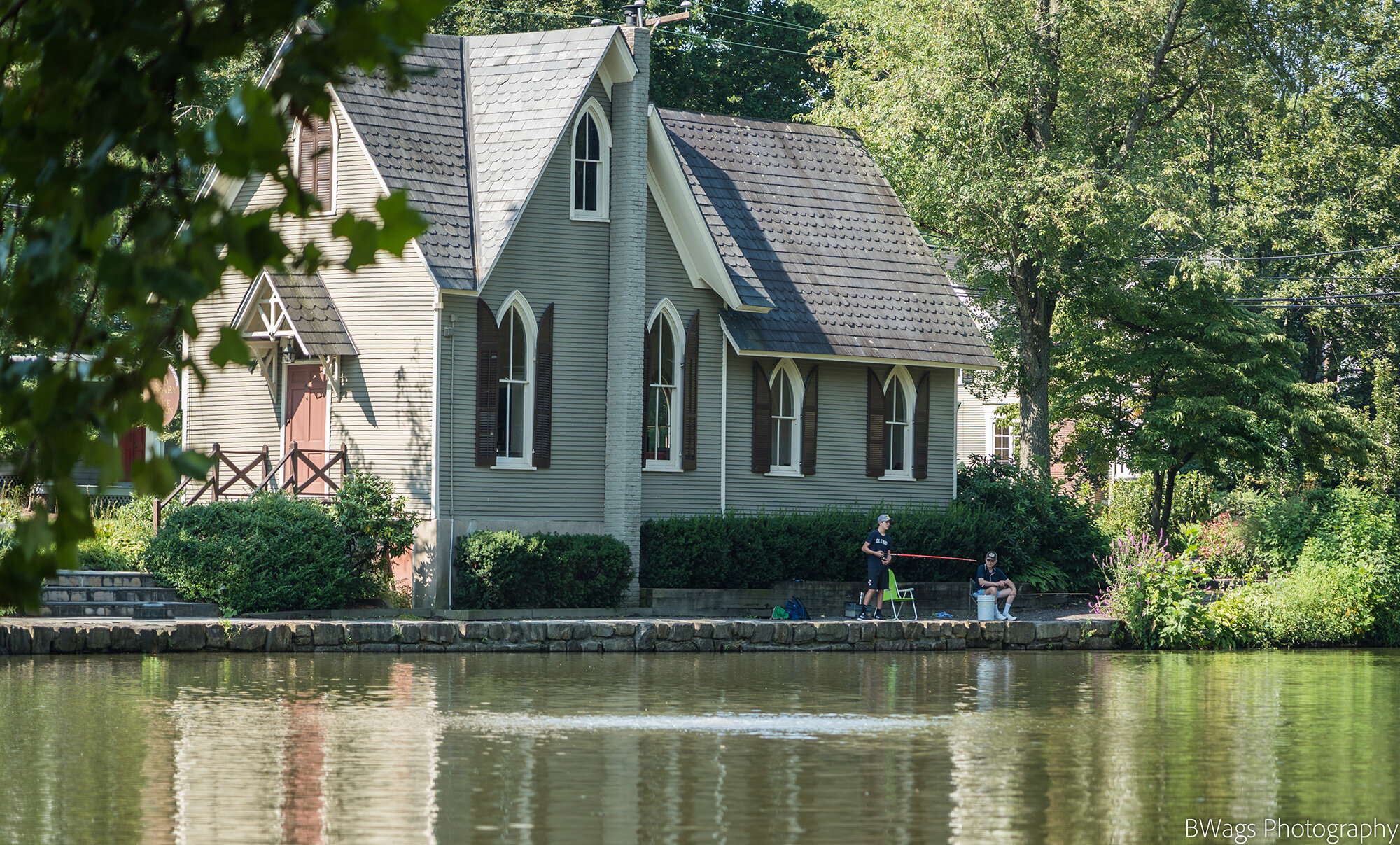
During the late 1800's, a number of large residences with views of Lake Afton were constructed along the south side of West Afton Avenue. The Old Library by Lake Afton, a Victorian Gothic structure, was built in 1878. On view in the library is a collection of photographs, books, documents and artifacts relating to Yardley's history. St. Andrew's Episcopal Church, constructed in 1889-1890, is a brownstone structure with a stone parish house.
The majority of the buildings within the historic district are found on South Main Street.
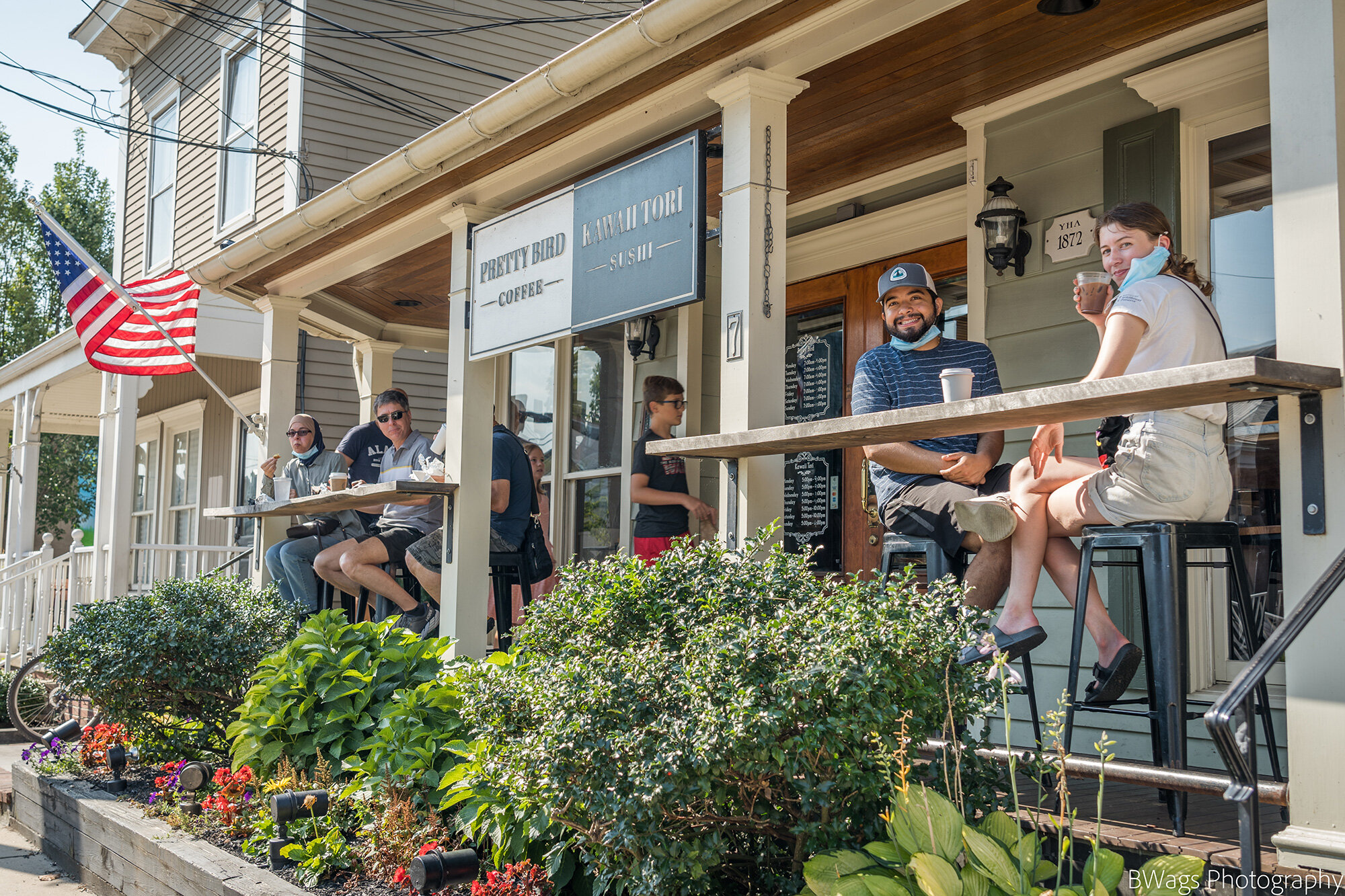
Both sides of the street are lined with closely set buildings, many of which have been adapted to commercial use. Even if used commercially, the buildings reflect a sensitivity to architectural integrity. Landscaping fosters this impression. The trees and shrubs planted within building setbacks from the street enhance the residential feel of the neighborhood, and in turn, the entire historic district. Rich in diversity of style, houses along South Main Street include examples of Second Empire, Queen Anne, and enhanced Victorian Gothic architecture.
The buildings at the intersection of South Main Street and East Afton Avenue form the commercial center of the town. This area of the Borough has undergone extensive rehabilitation through the years. Many of the buildings are over fifty years old and have gained their own historic significance.
The historic district continues along the west side of South Main Street. Juxtaposed with late nineteenth century commercial buildings is a shopping center constructed in the mid 1900s. On the east side of the street is the last nineteenth century brownstone bank building. Continuing south, the brick Colonial Revival Post Office and Borough Hall, constructed in 1916, are found.
The historic district encompasses both sections of Canal Street, which runs parallel to the Delaware Canal. The areas in both sections are dotted with small, predominantly frame structures dating from 1840. Along the southernmost section of Canal Street is the small, frame Yardley-Bethel A.M.E. Church built in 1877 and several early twentieth century double houses.
Similarities And Differences
The origin of Yardley Borough is similar to that of two other river villages, Morrisville and New Hope. Each of the villages developed along the Delaware River where streams were used to power mills. By the early eighteenth century, the villages had become the focal points of roads and ferries. Each of the three villages grew throughout the eighteenth and nineteenth centuries with a dramatic increase in development after the opening of the Delaware Division of the Pennsylvania Canal in 1831.
In the mid to late nineteenth century, the early ferries were replaced when each town was connected to New Jersey by means of a bridge over the Delaware River.
Yardley Borough differs from Morrisville and New Hope because it does not have the large manufacturing buildings, the great numbers of workers' small houses that traditionally accompany such businesses, nor the numerous ancillary businesses and development that are usually found nearby. Yardley never developed into a large milling and manufacturing center. With the exception of the original grist mill complex, there was little large scale manufacturing and commercial activity until later in the nineteenth century.
Yardley was the hub of numerous transportation lines established in the eighteenth, nineteenth and early twentieth centuries. It was an important nineteenth century commercial distribution center for the surrounding agricultural farmland of Lower Makefield Township after the opening of the Delaware Division of the Pennsylvania Canal. Major periods of significance for Yardley include 1) the first quarter of the eighteenth century when Thomas Yardley established the ferry and mill, 2) 1790-1810 when Thomas Yardley, the son of the original Thomas Yardley began the process of selling his property which rapidly led to the establishment of a village on the site, 3) 1830-1850 which reflects the large scale development that followed the opening of the Canal and 4) 1870-1890 when the railroad ran a line and opened a station just south of the established village.
The theme of Yardley as an important regional transportation hub continued into the early twentieth century when the Yardley, Morrisville and Trenton Street Railway Company was connected to the Newtown-Yardley trolley line in June 1903.
The net result of Yardley's growth from a mill seat and ferry crossing into an independent borough is a distinct assemblage of eighteenth and nineteenth century buildings with a well-defined and cohesive historic district. This is due to the very small percentage of intrusion within the historic district boundaries and the overall effect of the design and setting of the town's buildings. The vast majority of the buildings are oriented to narrow streets and are set closely to each other on this deep lots. Although the buildings in the commercial district are less unified in design, size and integrity, these adapted buildings do not detract from the historic elements that give the historic district its distinct sense of time and place. There is a true sense of entering a town when one enters Yardley Borough.
Copyright © 2011Yardley Borough Hall • 56 South Main Street • Yardley, Pennsylvania 19067